Friday, 11 July 2014

Was JFK a Doughnut?

On June 26th 1963 U.S. President John F. Kennedy spoke to the people of West Berlin in a statement of solidarity.  The result has become a much derided phrase:
"Ich bin ein Berliner"

 What JFK actually intended was to declare "I am a citizen of Berlin".  Ein Berliner, however, is a popular variety of doughnut.  The implication of this being that he should have said:
"Ich bin Berliner"
Nationalities are not treated as "countable" in German.  You can't individually be many citizens of Berlin - unless you have split personality disorder - so this makes sense.  The limit is set by the personal pronoun rather than the noun's article, so the article is removed and the noun treated more like an adjective.

I've never had any reason to question this...until recently.

Listening to a BBC Radio 4 podcast I was casually informed by a translation expert that this little joke at the expense of the late President Kennedy was actually utter nonsense.  "Ich bin ein Berliner" means exactly what was intended.  JFK was not claiming, in a moment of madness, to be a doughnut - metaphorical or otherwise.

Now, I'm not one to argue with the BBC.  So I'm calling for debate.  Can anyone shed light on this claim?  All I see is doughnuts, but my ears and eyes are wide open.

Wednesday, 9 July 2014

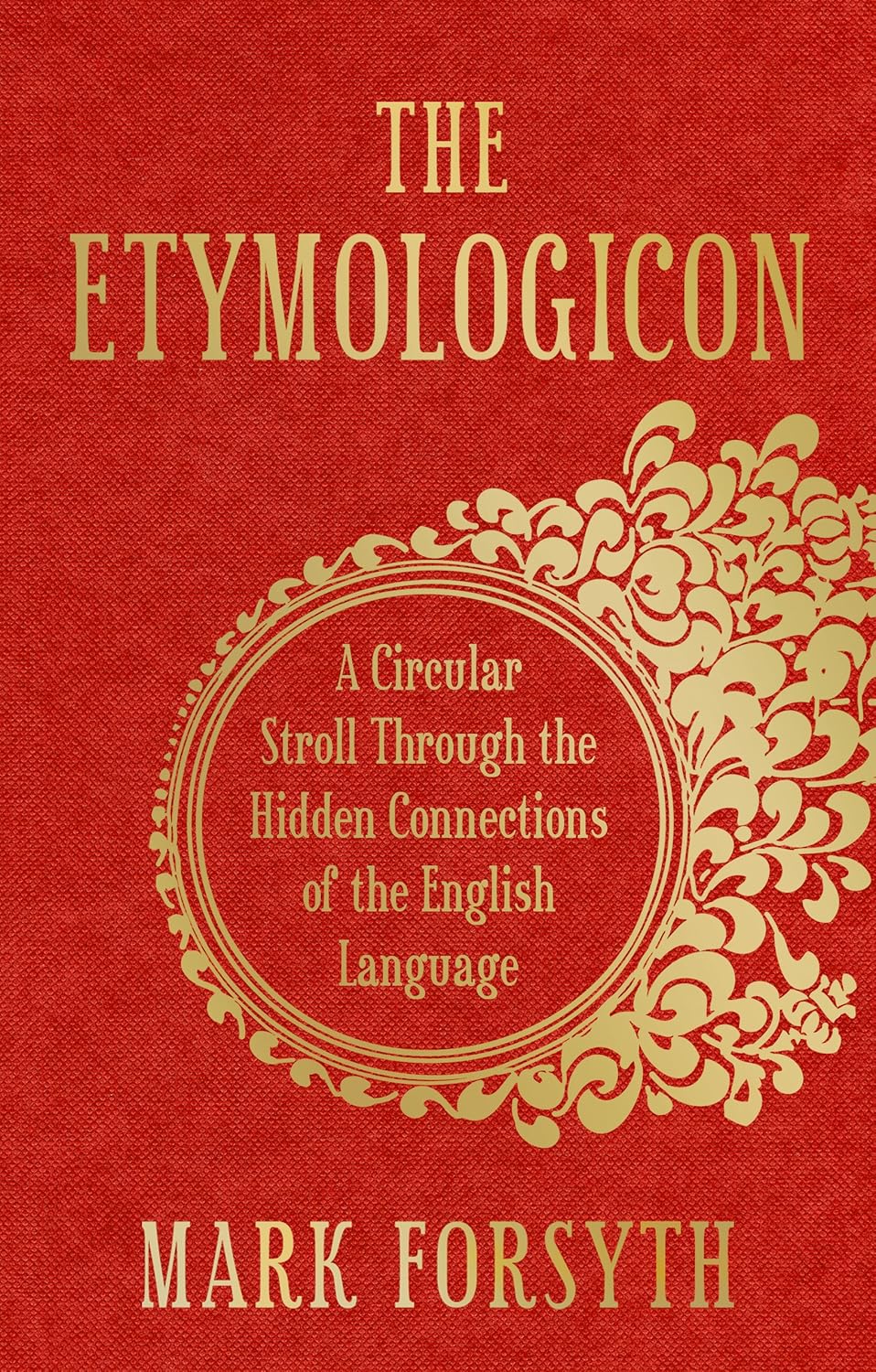
The Etymologicon

If you invest even the slightest interest in the workings of language and the origin of words then this is a must read.


Why?

Well firstly it's not a difficult read, neither is it a patronising one.  I won't claim to follow absolutely every thread, but I didn't feel like I was missing the point as a result.  Where possible this is written in plain terms that pretty much anyone could follow

The Etymologicon is also neatly arranged into short, manageable sections, making it ideal to pick up and read when you have a couple of minutes spare.  These sections, moreover, link neatly to one another, so if you feel like a more substantial session your read won't feel stilted by the segregation.

We also have humour and pedantry in the same place, which Eats, Shoots and Leaves demonstrated is a viable, and wonderful combination.  The Etymologicon is better than Eats Shoots and Leaves though, as there is no hint of accusation in its pedantry.  This is the pedantry of a person who has a passion for language, not a bee in their bonnet about folks misusing apostrophes.

Mostly though it's a great lesson about the misguided assumptions we make about our own language.  I was fascinated to learn that so much of our language was actually bought back from exotic climes by explorers (you'd be astonished at the number of arabic and indian influences on our language), and that so much of it was simply invented by creative authors with sufficient influence.

...and then so much more is the result of butchering, laziness, and misunderstandings through the ages that have evolved our language.

WARNING:  This book may cause you to bore the crap out of your loved ones, without even understanding why.

Wednesday, 7 August 2013

FRENCH GRAMMAR: Indirect Object Pronouns

Indirect Object pronouns are often difficult to explain/understand as an English speaker.

In the image below featuring an androgynous "moi" I hope, if not to explain, then to illustrate the relationship between the indirect object pronoun "me" and "verb+à" constructions.


Sometimes in French a subject (elle) may wish to give/say something to (à) an object (moi)

The structure for saying and giving is:

Dire quelquechose à quelqu'un (to say something to someone)
Donner quelquechose à quelqu'un (to give something to someone)

...where quelquechose (something) is a direct object and quelqu'un (someone) is an indirect object

The à is a clue that the object that follows is indirect, as it forms a barrier between the verb and the object - allowing no direct relationship between the two to form.

...and the indirect object pronoun to represent "me" is ... "me"

...a lot of complicated grammar to explain a word that is the same in French as it is in English.

Tuesday, 6 August 2013

FRENCH IDIOMS: Pants and Wet Fingers

Please excuse the rather lewd-appearing post title - this post is actually an examination of English idiom "By the seat of one's pants".

Here we find yet another idiom that doesn't quite translate between French and English in the way one might expect, for there is no pantalon, and no culottes to be found in the French approximation.

...instead, we express it with a wet finger:

au doigt mouillé.


The etymology behind the French idiom has actually shed some light for me on the problem of translating from one thing to the other:

They don't quite mean the same thing.

An action performed au doigt mouillé is one that is approximate; imprecise.

An action performed by the seat of one's pants is improvised; instinctive; intuitive.

The French idiom originates from the tradition of holding a moistened finger up to assess which way the wind is blowing - we can use this to tell us approximately in which direction the wind is blowing, but not precisely.

In a sense this could be seen as improvisation in the face of insufficient resources/tools, which is probably why au doigt mouillé is considered a reasonable translation of by the seat of one's pants.

all in all it is probably better to bring a more chaotic, less organised image to mind to help this one stick.  More like this:


A hand reaching through the water in an approximate, imprecise direction, resulting of the intuition and instinct of the person below the surface.


Wednesday, 31 July 2013

Language Tools - Memrise

Today I post my first ever review, of sorts, of a language learning tool:  a website by the name of Memrise


I was introduced to this site only a few days ago by a friend, a fellow language-learner, and I am already waxing lyrical about it's sheer inventiveness in using modern trends to allow the user to learn language in a fun, creative, goal-orientated and interactive manner.

In fact I think this may be the first language-learning method that I have come across to combine all four of these elements.

Websites of this kind are rare as it is, even rarer with the impending closure of my previous favourite, Wordchamp.  But Memrise has an extra trick up its sleeve: you learn through memes, or 'mem's.

Sometimes these can take the form of text:


other times they can be images:


But, crucially, you can pick them yourself from user-submitted suggestions.  This means that:

1. You can pick a memory aid that resonates with you personally
2. Through selecting that aid you will be forced to process the other alternatives and anchor the word much more firmly by default.
3. If you have a better idea you can submit you own, that may go on to help other users.

Innovative, fun, creative, interactive.

You are then tested on your understanding of the vocabulary by multiple choice:


and by text input:


You are graded, and advised which words/phrases need revision, and how often, so whilst being engaging Memrise also manages to retain the need for goals and rewards that keep the learner on track and pushes them to do more.

Quite simply and outstanding tool!  If you're learning a language, especially as a beginner, I urge you to sign up and check this out.

I will most likely be creating lessons and memes of my own for my "Language Through Song" project that was looking a little too wordy and difficult to digest as a series of simple text posts.

A big 
THANK YOU 
to James for pushing Memrise my way!


Tuesday, 7 May 2013

LANGUAGE THROUGH SONG - WARLOCK (DORO) (#2)

32-46 seconds


GERMAN:
Keine Macht
Wird uns jemals trennen
(Ich) werde wie ein Tier d'rum kampfen
Du lernst mich kennen

ENGLISH:
No power
Will ever part us
I will fight like an animal for this
You are getting to know me.


VOCABULARY:
die Macht – power
jemals – ever
wie – like
ein Tier – an animal
darum; d'rum – therefore, for that reason


GRAMMAR:

Negation
Keine Macht”

Negation is usually expressed in German by placing “nicht” [nisht] after the verb:

Ich sehe (I see) [ish zay-uh]
>
Ich sehe nicht (I don't see) [ish zay-uh nisht]

In the source text example, however, we are negating a noun rather than a verb, to express the idea of there being none of that noun.

so...

die Macht (power)

becomes...

keine Macht (no power)

The 'kein' word replaces the usual article ('the' or 'a' word), as instead of having 'the power', now we have 'no power'


The Nominative Case
Keine Macht”

German has four cases, we will look at just one in this instance – the nominative case.

The nominative case acts on the subject of a sentence, or the person/thing in the sentence that is 'doing' the verb.

e.g. The cat sits on the mat.

In this instance 'the cat' is the subject of the sentence, as it is doing the sitting.

'The mat' isn't doing anything. It is being sat on, so it is the object of the sentence – the person/thing that the verb is being done to.

The nominative case is also used for some sentence objects – usually those being subjected to the verbs 'sein' (to be) and 'werden' (to become)

The articles for the nominative case in German are as follows:

Definite Article: (the)

masculine – der
feminine – die
neutral – das
plural – die

Indefinite Article: (a)

masculine – ein
feminine – eine
neutral – ein
plural – eine

The source text example uses a 'kein-' word, rather than an article. To get the correct form of this for the nominative subject, simply add a 'k' to an indefinite article:

eine > keine


VERBS:

trennen – to separate; to part (future tense)
Ich werde trennen – I will separate [v-air-duh trenn-un]
du wirst trennen – you will separate (informal singular) [veer-st trenn-un]
er/sie/es/man wird trennen – he/she/it/one will separate [veer-t trenn-un]
ihr werdet trennen – you will separate (informal plural) [v-air-det trenn-un]
wir werden trennen – we will separate [v-air-dun trenn-un]
Sie werden trennen – you will separate (formal) [v-air-dun trenn-un]
sie werden trennen – they will separate [v-air-dun trenn-un]


kampfen – to fight (future tense)
Ich werde kampfen – I will fight [v-air-duh kamp-fen]
du wirst kampfen - you will fight (informal singular) [veer-st kamp-fen]
er/sie/es/man wird kampfen – he/she/it/one will fight [veer-t kamp-fen]
ihr werdet kampfen – you will fight (informal plural) [v-air-det kamp-fen]
wir werden kampfen – we will fight [v-air-dun kamp-fen]
Sie werden kampfen – you will fight (formal) [v-air-dun kamp-fen]
sie werden kampfen – they will fight [v-air-dun kamp-fen]


kennenlernen – to get to know; to meet (present tense)
Ich lerne kennen – I am get too know [lair-nuh kennen]
du lernst kennen – you are get to know (informal singular) [lair-n-st kennen]
er/sie/es/man lernt kennen – he/she/it/one is getting to know [lair-n-t kennen]
ihr lernt kennen – you are getting to know (informal plural) [lair-n-t kennen]
wir lernen kennen – we are getting to know [lair-nun kennen]
Sie lernen kennen – you are getting to know (formal) [lair-nun kennen]
sie lernen kennen – they are getting to know [lair-nun kennen]

(#1).(#2)