Tuesday, 17 November 2015

Reasons to love Japan: Whisky

Miyagikyo Japanese Whisky

When most of us think of Whisky we think of Ireland or, more probably, Scotland as the leaders of the market; producers of the finest whisky.

I always believed this to be the case, and thought that I simply was not a fan of whisky, having tried a few of the more popular brands stocked by British pubs.

Then the popularity of cocktails took off, there were cocktail bars on every city street corner, and I started experimenting more with my drinks.  I soon discovered that I loved short, whisky-based cocktails.  So why didn't I like whisky?

I started enquiring in cocktail bars; learning about the brands that they used and recommended, and trying them neat.  This journey of discovery also led me to my local whisky shop.

I never expected my whisky of choice to be of Japanese origin.

Image from The Whisky Exchange.  Link to article below

Now, I mean no hyperbole:  my preference is wont to change, and I am far from an expert on whisky so cannot claim to know what is "best", I would simply recommend to people not to always to look in the obvious places for good whisky.  My own experience of Scottish and Irish whiskies, whilst limited to commercial brands, is of a lack of subtlety for the nose and pallet and an alcoholic burn that overpowers any flavour.  My experiences with Japanese Whisky, so far, have been far more nuanced.

But that's enough of my opinions!  For anyone wanting to learn a little more about Japanese Whisky, please check out the link below to an article from The Whisky Exchange

Thursday, 12 November 2015

Language Learning Tips for Beginners: Dictionaries

Whilst I am always an advocate of a full, hard-back dictionary - the kind that you could cause some serious physical damage with - I do feel that in these modern times, where there is so much technology is at our fingertips, it is OK to supplement the old with something a bit more new and shiny.

So it is not only important to get acquainted with an online dictionary for your chosen language, you will also need to "shop around" to find the best dictionary to suit your needs.

Your needs will depend upon your goals, chosen language and linguistic background, but I have compiled a list below of some of the things that you may need to consider when choosing a good online dictionary:

Interface & Functionality
  • Is it clearly laid out?
  • If you are likely to require mobile use, does it function well on your Smartphone?
  • Is the source language to target language ratio reasonable?  (i.e. can you understand the basic functionality of the dictionary, or would you need to break out your hardback to get that far?)
dict.leo.org - great German dictionary, but not an English word in sight.

  • Does it have a search function?  Sounds daft, but many online dictionaries still rely on selecting words from pages of alphabetic lists.
  • Are translations available in both directions? (i.e. target>source and source>target).
  • Are you able to type in your target language?  If you are learning a language with specific accents or a non-roman alphabet, is there a facility to accommodate this?
ce.linedict.com allows you to search new chinese characters by drawing them

Grammar
  • Are example sentences provided for context?
  • Are noun plurals provided?
  • Are noun genders provided?
  • Are verb tables handy and clear to decipher?
  • Is the word class elucidated (i.e. adverb, adjective, verb, noun,...)
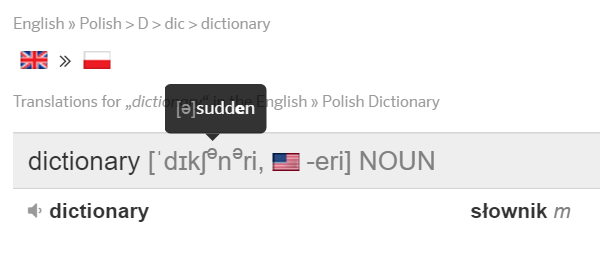
en.pons.com provides phonetics, phonetic breakdown, word class and noun gender.

Pronunciation
  • Are phonetic details provided?  I am a huge fan of learning the phonetics of a language alongside the vocabulary as I feel it really opens up some of the more daunting aspects of a language (i.e. the tricks to knowing pronunciation from a words spelling alone).  If you have a technical mindset then this can make those extra "z"s and "x"s a lot less scary very quickly.
wordreference.com provides sound files and phonetics
  • Are sound files available?
Community
  • Is there an advice forum for those really tricky translations?  How easy is it to sign up to use this feature?
Usually, given a bit of research, you will quickly be able to identify which dictionary is the right one for you, but I hope that this list helps highlight the possibilities out there and gives some food for thought that might encourage some more active sourcing.

Happy Hunting!  Please feel free to leave recommendations for others in the comments.

Tuesday, 10 November 2015

Czech Music

The following are some czech language tracks featuring currently in Spotify's Czech Republic Top 50 and Viral Top 50 charts which, I'm hoping, will be accessible as a complete chart using the following links:


Etikety by Slza:

Nafrněná by Barbora Poláková:

and another lovely track I found just for good measure:

Ztracená bloudím by Verona

My Czech Language playlists (currently in their infancy) can be accessed on the links below.  I will be building upon these periodically.  Please share with me your recommendations:


Sunday, 8 November 2015

UK Travel: Bewdley - Kateshill House


Kateshill House is a manor house turned B&B with seven 5 star rooms named after Tudor King Henry VIIIs wives and is located within 5-10 minutes walk of Bewdley's attractions.  

The rooms are a little on the pricey side, but justifiably so - they are lavishly furnished, comfortable and spacious.  We ended up spending quite a bit of time just relaxing in our rooms, sipping the complementary sherry, or wandering the grounds where there is an impressive garden and allotment all cared for by the owners themselves, who are very helpful and friendly.  

Did I mention the breakfast?  You can get a very nicely cooked Full English Breakfast with the price of your room (other options are also available - Salmon, for example). 

UK Travel: Bewdley

photo from bewdley.org.uk

For many the UK offers barely more than two visions for a retreat: The bustling cities, where one barely has time to take in a sight before being simultaneously swept along by the crowd and hit in the head with a selfie stick; or the breathtaking beauty of an isolated cottage entirely in the middle of nowhere.

photo from bewdley.org.uk

Bewdley, near Kidderminster, is a very happy medium:  a small town in the middle of a rapidly developing and expanding little island that maintains its character and authenticity;  its Britishness. The false, shiny "touristic" veneer that has been liberally applied to many coastward towns has not settled here.  Long may it stay that way.  As such Bewdley is a place for historic architecture, nature, charming cafés, rustic country pubs, great food, dog walking, Fish & Chips, feeding ducks and mingling with the locals...the links below offer a few tips from places I have stumbled across that are well worth a visit:

ACCOMMODATION:

KATESHILL HOUSE

FOOD & DRINK:

CLEMENTINE'S COFFEE
http://saywhat-uk.blogspot.co.uk/2016/04/uk-travel-bewdley-clementines-coffee.html
photo from Clementines' facebook page

more to follow...

Monday, 7 September 2015

Excited!!


One of these days I will stop getting excited about new languages that I could learn.  Clearly that day has not yet come.


Friday, 17 April 2015

Tips for Reading Foreign Languages


So, you're studying a foreign language and you find yourself facing a rather daunting text.  What do you do?


You could run away screaming, but you may not get that luxury if you're a student or using the text in a work assignment.

Or you could just be punishing yourself to further your vocabulary or comprehension skills.  Oooooor you could be suffering through notoriously difficult classical literature because you happened to see it at a second hand bookstore for an ABSOLUTE STEAL that it would have been criminal to pass up; the only drawback being that now you actually have to read the bugger.

So...this is me...here I am on book 1, page 22 of Marcel Proust's 7 book series A La Recherche Du Temps Perdu.  And here's how I'm tackling this monster...
Tip #1 : Put down the dictionary

It will only distract you as the temptation to open it every 5 words will be too great.  Factor in 10-line sentences peppered with commas and you'll quickly find yourself losing track of the meaning of the whole, for the sake of the meaning of just one word.  9 times out of 10 it will only be an incredibly obscure, archaic, mostly useless word anyway and you will get frustrated chasing after these red herrings.  

Reading through without a dictionary will also train you to read around the words you don't know and figure out the wider meaning through context - a very important skill.  Vocabulary is important too, though.  Note down new words as you go along and come back to them later; keeping track of the page number just in case you should need to come back to the context.

Tip #2: Take regular breaks

Trying to speed read foreign texts will get you nowhere.  You'll quickly find yourself zoning out and realise that instead of taking in anything at all from the text you have been day-dreaming about what you're going to have for dinner, or silently congratulating yourself on the progress that you are not making.  Regular breaks whenever you feel your mind wandering will keep you focused.

Tip #3: Treat yourself

Reading that early 20th Century 400-page classic French literature is not a chore, it's an opportunity for some "me" time.  Treat yourself to a bite to eat or a coffee in that new café that's opened up nearby or, if the weather's nice, head to your nearest beer garden for a crafty cocktail in the sun.  Just today I took my Proust with me to watch the FA cup semi-final and enjoy a milkshake and freshly-baked pretzels at Coast to Coast in Birmingham.  Granted I didn't get too much reading done during the football, but reading was a great way to look like less of a sad, lonely type during half-time!
Tip #4: Engage

No matter how stupid, boring or meandering the text you need to constantly challenge yourself that you are understanding what you are reading.  At logical breaks in the text ask yourself quick questions about what it happening, take brief notes about important plot points or character traits that you can come back to later.  Try as much as you can to place yourself in the scene, and keep it light.  Writing irreverent or amusing notes can really cement a story and characters in your head and will make it easier to follow their progress going forward.  As a suitable sign off, here is what I believe I have learnt from pages 14 - 22 of Du côté de chez Swann:
  • Plot - What has happened? ABSOLUTELY NOTHING!!!
  • There are too many characters.  None of them have names except for M. Swann.  Let me get out my family tree...this is War & Peace all over again!
  • Character - M. Swann - consequential character of no apparent personality.  He has a wife and a dead father.  He is protagonist's neighbour.  He seems to be a social pariah of sorts and figure of derision.
  • Character - the great aunt - stubborn cow who contradicts popular opinion for no good reason.  Not a fan of M. Swann on account of his lack of breeding/class - snob!
  • Character - the grandmother - opposite of great aunt.  A bit too fluffy.  Seems to like everyone.
  • Character - the protagonist - whiny bitch who doesn't like M. Swann (or any other visitors for that matter), as whenever they have company at home he is made to go to bed slightly early and without that (slightly too) cherished kiss from Mummy.  He does usually still get a kiss, but he seems to prefer to be undressed, alone with Mummy, and in bed for this, rather than fully dressed and in company.  Definite Oedipal complex in the making!
Language learning can be tough and unforgiving - you've got to search for your own rewards, so whatever you're doing be creative and have fun!